Reviewing Digital History: An Introduction
Jasmine Harris | OCT 31, 2024
Reviewing Digital History: An Introduction
Jasmine Harris | OCT 31, 2024
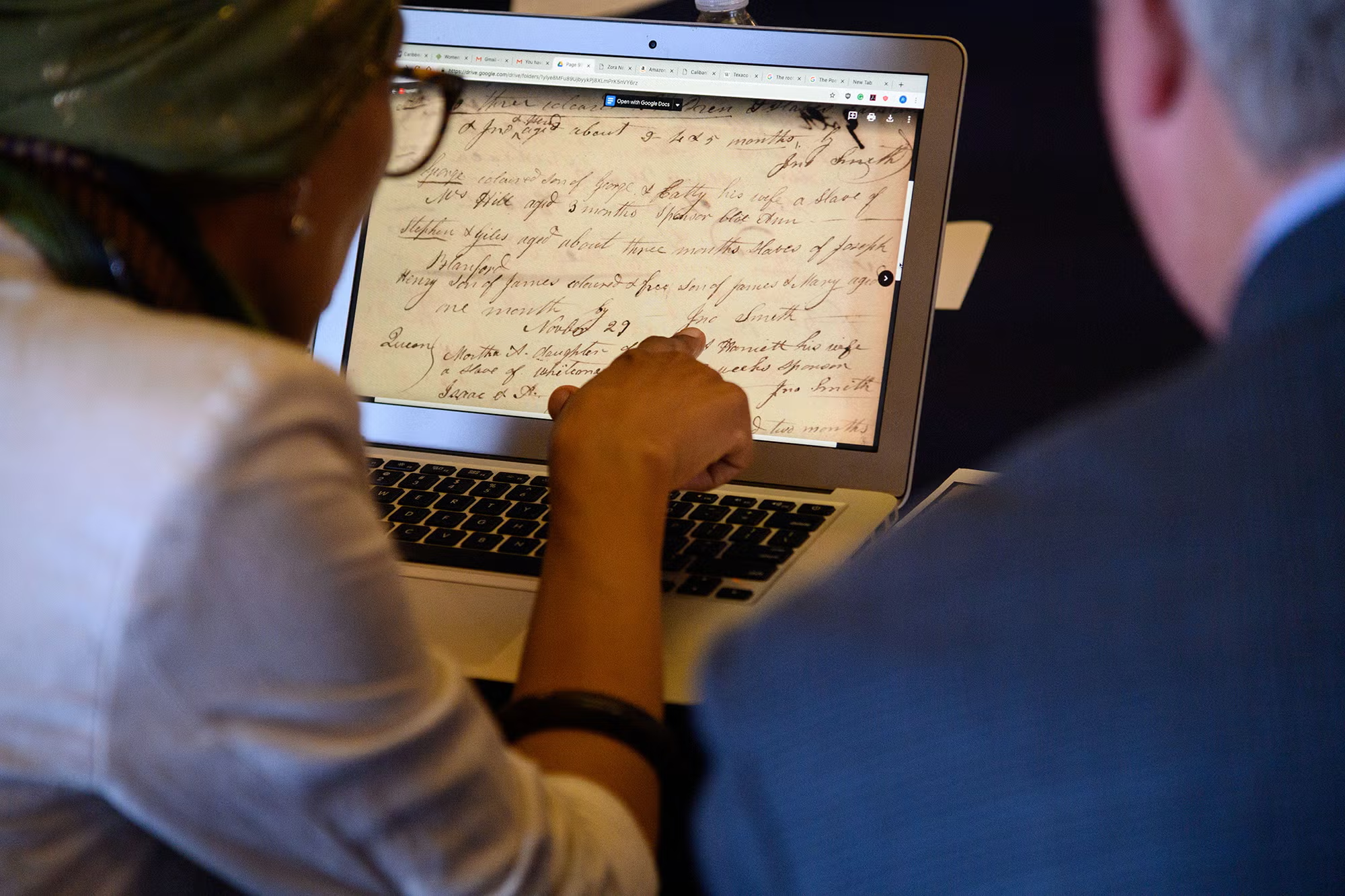
I found the Georgetown Slavery Archive instrumental in providing access to lost memories. The six collections bridge the past with the present [4]. Such an archive can be a crucial tool in filling gaps in collective memory. For descendants of Georgetown’s enslaved individuals, the archive provides a means of reconciliation [4]. It is important to note that this repository was intentionally designed to bring silenced voices to the forefront. Previously, the archive was not designed with this in mind and focused on the study of enslavers and white elites [4].
The project aims to foster engagement and dialogue among various groups, including academics, students, and African American descendants. This passage highlights additional features of the Georgetown Slavery Archive, emphasizing its educational and analytical tools. The “Map” section enables geospatial analysis, illustrating the impact of the 1838 sale of enslaved individuals on both the university and those sold to Louisiana. The “Gallery” section, while useful, could benefit from more instructional guidance to enhance its use in educational settings.
The design of this archive enriches reconciliation. I believe there are levels of reconciliation that could be further broken down to align with human memory or types of memories. By human memories, I mean those related to the senses: visual, auditory, tactile, and taste. While a digital archive can only do so much, it does appeal have an appeal to memory and reconciliation by showcasing historical documents, court testimonies, photographs, obituaries, oral histories, and ephemera. This form of memory can act as a catalyst for reconciliation, allowing descendants to connect with the past through photographs or the depth of audio -voice in oral histories.
There are various levels to accessing memory. For example, I once hosted a restorative yoga class geared towards meditation and rest. An older woman in her 50s experienced flashbacks to being a young slave girl navigating her town, memories she could not initially understand. She told me that she had these recurring memories since she was a teenager, despite not living in that era. As she grew older and conducted her own research, she realized that Charleston, South Carolina, where she grew up, was notorious for its auction block slave markets. She believes she accessed some form of memory, and her research helped her make sense of these memories. I can only imagine what additional memories or forms of clarity and reconciliation she might achieve if she had access to an archive like Georgetown’s but for Charleston.
Similarly, when I hear police sirens or get pulled over, an instinctive wave of anxiety comes over me, stemming from the collective memory of Black people’s relationships with the police; although I know I am safe it is just a collective memory that gets accessed. This serves as a form of somatic memory. These examples demonstrate the layers of memory and reconciliation, which need further research to provide stronger validity, even though I already know this to be true. The challenge is proving it to others, especially within a Western construct.
Projects like Digital Harlem invite users to access “everyday Harlem” [1]. This project aims to explain the decline and resilience of the neighborhood’s residents through effective interface design, search functions, and aesthetically appealing layouts [1]. However, weaknesses in data selection and organization can hinder user connections [1]. This can undermine the site’s utility, especially if its aim is to jog human knowledge or memory. Digital projects like this help us see and make sense of new insights that are not immediately apparent; some things need to be mapped out and then extracted. The Digital Harlem project uses geo-references with data points associated with various information locations extracted from mentions of people, places, or events [1]. This provides the groundwork for creating atlas-like resources. However, without proper data and contextualization, this can lead to confusion. Proper data and contextualization lead to memory access. For example, mappings explain parade routes affiliated with Marcus Garvey’s Universal Negro Improvement Association or the prevalence of beauty parlors operating in various forms. These contribute to the reconciliation of memory and highlight the importance of these establishments in grounding social life in Harlem [1].
McClurken argues that there is often a contradiction between the designer and the end-user in digital projects. He asks how we can fit digital humanities into ongoing and future history-writing. Due to the constant change within the digital world, we should be mindful of intentionality because projects can take unintended directions, raising ethical concerns and concerns of the public -end user experience [3]. McClurken introduces the concept of the context of creation [3]. Digital projects do not have to aim at one audience but can have tiered levels of expectations based on who the project is aimed at. We must remember that these projects are usually public facing. Designing intentionally how the public can interact with the content is also crucial. McClurken notes that projects with great impact and depth seem to contribute significantly to the greater sum of human knowledge [3]. I think human knowledge could be synonymous or interchangeable with human memory in certain contexts.
Footnotes
Bibliography
“Born-Digital Reviews: An Introduction.” The Western Historical Quarterly 46, no. 3 (October 2015): 394–394. https://doi.org/10.2307/westhistquar.46.3.0394.
Downs, Gregory P. “Freedom on the Move: A Database of Fugitives from American Slavery. Https://Freedomonthemove.Org/.” The American Historical Review 125, no. 2 (April 1, 2020): 586–87. https://doi.org/10.1093/ahr/rhz718.
Georgini, Sara. “Reviewing Digital History.” The Junto (blog), January 20, 2015. https://earlyamericanists.com/2015/01/20/reviewing-digital-history/.
Green, Hilary. “The Georgetown Slavery Archive. Http://Slaveryarchive.Georgetown.Edu/.” The American Historical Review 125, no. 2 (April 1, 2020): 587–89. https://doi.org/10.1093/ahr/rhaa186.
Sternfeld, Joshua. “Harlem Crime, Soapbox Speeches, and Beauty Parlors: Digital Historical Context and the Challenge of Preserving Source Integrity.” The American Historical Review 121, no. 1 (February 1, 2016): 143–55. https://doi.org/10.1093/ahr/121.1.143.
Jasmine Harris | OCT 31, 2024
Share this blog post
 OfferingTree